
Objective
- High inspection effort required for self-loaded pallets with up to 128 boxes, about article and batch purity, including data comparison with their ERP
Results
- Time saving per inspected pallet
- Reduced personnel costs through automation
- Reliable processes thanks to automatic data comparison
- Higher employee satisfaction
- No training required
 Jagdwurst, Kassler, or Bierschinken: these and other culinary specialities can be found not only in traditional butchers' shops, but also in the fresh food counters of supermarkets and discounters. Hygienically packed in plastic trays, the products are conveniently ready to grab from the shelf. These products often originate from the municipality of Garrel in Lower Saxony, Germany, where the Goldschmaus Group operates one of the country’s largest slaughterhouses. The meat and sausage products produced here are marketed worldwide, with the entire value chain QS-certified. Sustainable monitoring also ensures the traceability of animals and feed. Tim Buddemeyer, General Operations Manager, who has precisely structured the packing and storage process with this in mind - and this is how it works:
The products intended for the self-service area are packed into boxes of up to eight units and labelled. Between 32 and 128 such boxes ultimately form an article- and batch-pure pallet, which several employees load in a matter of minutes. The boxes are supplied via a roller conveyor, which transports the goods fully automatically from the production line.
The next step is to check whether the pallet consistently contains the correct products from a uniform batch. To do this, the barcodes of all boxes must be scanned and compared with the data stored in their ERP. The labels are predominantly equipped with a datamatrix code. Simultaneously, the pallet is weighed, and the result is compared with the calculated weight.
What sounds like a tremendous amount of manual effort only takes a few seconds at Goldschmaus. Ultimately, the company has invested in the smart automation solution ZetesMedea ImageID. "ZetesMedea ImageID has enabled us to maximise the safety and quality of our control processes. Instead of requiring two or three employees, the process now only requires one, allowing us to use our personnel capacity even more efficiently. This investment is expected to deliver a full return in less than two years."
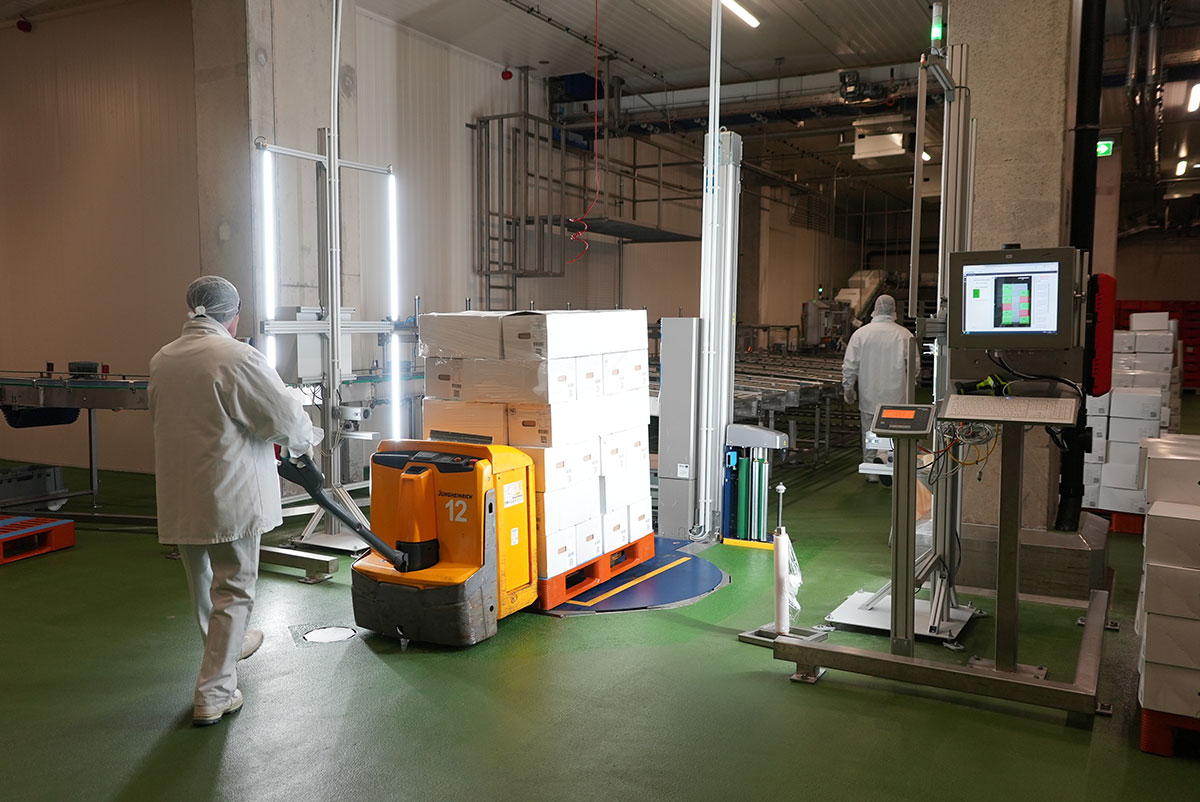
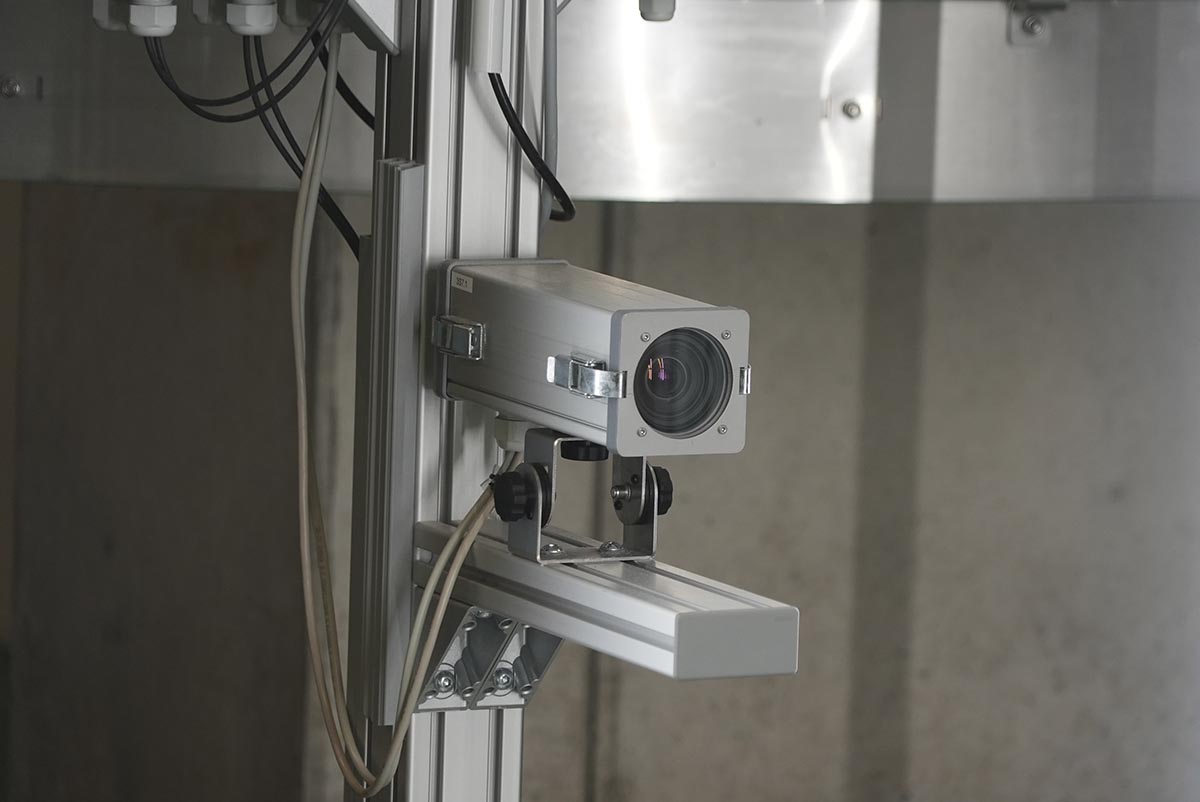
Now, an employee only needs to drive the pallet onto a turntable equipped with load cells, located between two Zetes ImageID cameras. The turntable is part of a pallet wrapper, whose function can be used independently of the ZetesMedea ImageID system. The other components include a traffic light and a workstation with a mobile scanner, a label printer, and a monitor. The monitor displays the user-friendly, web-based ZetesMedea user interface (Web UI).
"Thanks to ZetesMedea, we have a tamper-proof process and have achieved our zero-defect goal. We are delighted with the overall result." Tim Buddemeyer, General Operations Manager, Goldschmaus Group
After placing the pallet between the two cameras, the employee starts the scanning process by pulling a rope switch. The scanning process now begins, and the weight of the pallet is determined and transmitted to their ERP system with all the necessary information. After a few seconds, the graphically prepared result appears on the monitor. If everything is correct, the traffic light also turns green. Now the label printer springs into action, automatically generating a master label with ZetesMedea. Once affixed to the pallet, it is ready for storage in a movable shelf system where the products await sale.
 If the light does not turn green, it is often due to the packing pattern of the boxes on the pallet not being correctly aligned. If necessary, the pallet must then be rotated 90 degrees via the turntable for a second scan. If individual barcodes are not recognised during scanning, for example, because they are damaged or obscured, the light turns red. In these rare cases, the boxes concerned are colour-coded on the pallet image shown in the Web UI. This provides the employee with visual assistance, allowing them to correct the missing data specifically and without prolonged searching, and to capture it subsequently with the manual scanner. After rectifying the errors, the process is completed as described above. The procedure is self-explanatory and intuitively understandable, so the employees did not require special training.
"Thanks to ZetesMedea, we have a tamper-proof process and have achieved our zero-defect goal. We are delighted with the overall result," Buddemeyer sums up. Goldschmaus now has three similar installations of ZetesMedea ImageID (with and without turntables) at the Garrel and Oldenburg sites. In addition to boxed goods, food-grade Euro-norm HDPE containers are scanned with it. These reusable pool crates have a separate code that is also read by ZetesMedea ImageID and linked to the product code.
--
About Goldschmaus
Goldschmaus, one of Germany’s leading meat producers, consolidates all steps of beef and pork production under one roof. The meat and sausage specialities with guaranteed German origin produced at the Garrel and Oldenburg sites are marketed worldwide. Up to 8,400 pallets of frozen goods are dispatched each month.
The Goldschmaus Group employs around 2,100 people, generating an annual turnover of EUR 727 million. Per year, Goldschmaus slaughters 1.7 million pigs and cuts up 90,000 cattle. A large portion of transport is handled with 42 of its own refrigerated vehicles and 21 livestock transporters.