A player in the ultra-fresh market with stringent logistics requirements
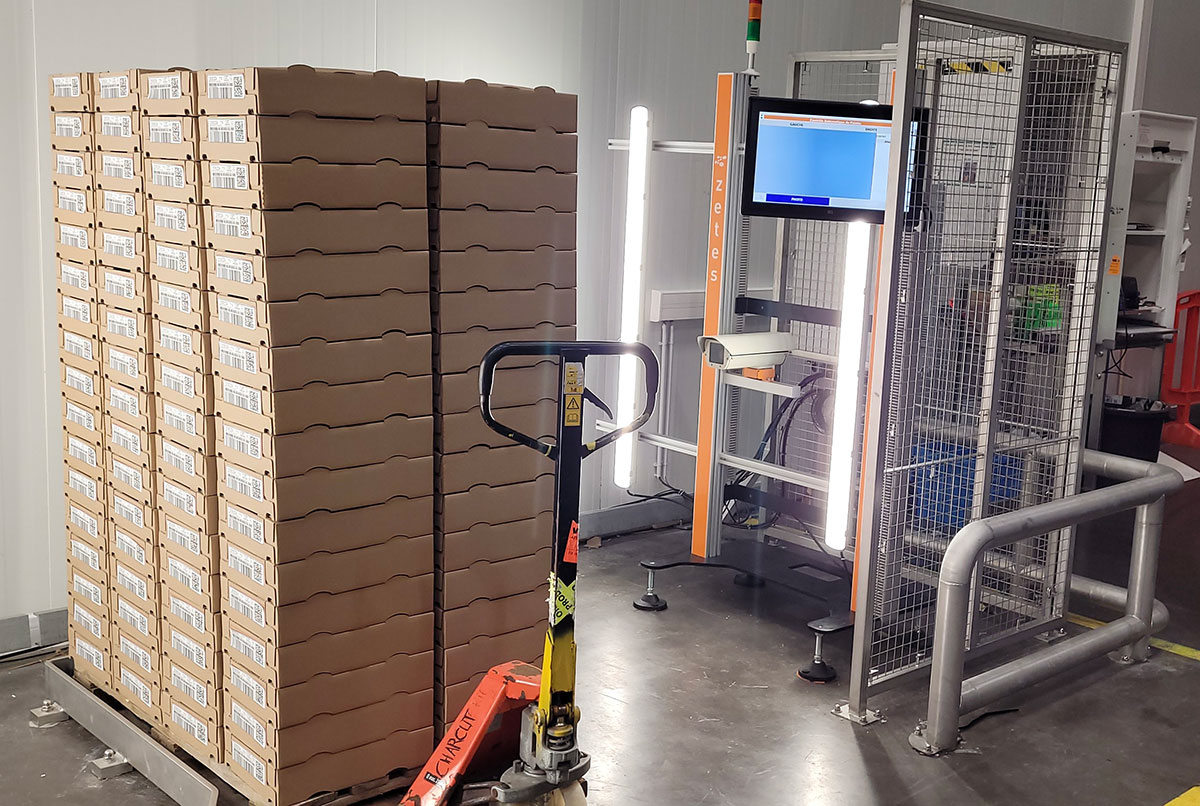 Kermené, a French agri-food company and exclusive supplier to E.Leclerc supermarkets, ships nearly 100,000 boxes a day on average from its production facilities. The company operates in an ultra-fresh sector where there is no room for traceability errors. Arnaud Valet, Head of Tertiary Processing Plants and Supply Chain at Kermené, says: “We deliver to 1400 points of sale every day. This requires end-to-end traceability that must be flawless.”
With 4000 employees, seven production facilities, and a highly automated supply chain, Kermené depends on the performance of its tools to guarantee product quality and food safety, and to uphold the brand image.
A need for consistency and automation in pallet control
Some manual operations used to generate occasional discrepancies in the labelling or composition of pallets. In a context where a single incorrectly identified box can cause a hygiene or logistics problem, Kermené wanted to automate its pallet control process, making it more consistent.
The purpose was twofold:
- To guarantee unit-level traceability per box, with a unique number for each parcel,
- To ensure a reliable count of the quantities actually present on each pallet.
“We needed to be able to identify the exact number of boxes on a pallet leaving the factory, with the correct batch number, the right use-by date, and the right product. A single missing box could cause a real problem, so it was essential to have zero discrepancies, zero errors,” explains Arnaud Valet.
“Now all our pallets are scanned and checked as they leave the factory, which guarantees full traceability, box by box,” explains Alexandre Petroff, IT Managerchez Kermené.
ZetesMedea Shipping Verification: an automated, smart solution
Kermené chose ZetesMedea Shipping Verification, deployed via the 11 automatic camera gates installed across the five production facilities. The solution is based on ImageID technology, which can capture both sides of a pallet in a single shot.
Each pallet is checked as it comes off the line: the system scans all the Data Matrix codes, and checks the quantities, batches, product catalogue numbers, and use-by dates. “Now all our pallets are scanned and checked as they leave the factory, which guarantees full traceability, box by box,” explains Alexandre Petroff, IT Manager at Kermené.
The ZetesMedea Shipping Verification solution is designed to secure high-volume logistics flows.
It automatically compares the actual contents of a pallet to the expected data found in the MES (Manufacturing Execution System). The information collected (codes, images, compliance statuses) is transferred to the information system in real time, guaranteeing an immediate decision: compliant pallet or error detected, which would block the pallet before shipping.
Kermené and Zetes later enriched the solution by adding an artificial intelligence module. Images were collected on site and hundreds of photos of pallets were used to annotate each parcel precisely and to train an AI-based object detection model.
After several testing and optimisation phases, AI is now able to identify the following automatically:
- Labelled boxes,
- Unlabelled boxes,
- Missing or undetected boxes.
Alexandre Petroff, IT Manager at Kermené, points out: “Using artificial intelligence, we can now do much more than just scanning codes. This system provides an additional visual reading that can identify the actual presence of parcels on the pallet, even when a label is missing or illegible. This increases the reliability of pallet control and secures our production output flows even more.”
This shows how Zetes improves pallet control for a production output, through a combination of identification (scanning codes when a label is present) and automatic visual verification when scanning is not possible. This approach provides better reliability than manual checks, reduces the risk of errors and disputes, and secures shipments without disrupting the existing system, because it is integrated into the processes already in place to provide operational teams with the necessary visibility in real time.
Significant, measurable improvement in performance
Manual checks used to require 144 scans, taking longer than a minute. Automation now performs the verification in just 5 seconds. This saves labour amounting to 5 FTE, which can be reassigned to higher value-added tasks. Traceability is now 100% controlled, eliminating phantom boxes, composition discrepancies, and shipping errors. This consistent verification also boosts the safety of the ultra-fresh products: an area where inaccuracy is not permissible. “Clearly, the big win in this project is about traceability. To us, this partnership with Zetes is like taking out a comprehensive insurance policy,” Arnaud Valet adds.
A partnership founded on co-construction and a long-term vision
The project was carried out over a year and a half and was based on close collaboration between the Kermené and Zetes teams. The co-construction approach, the responsiveness of the project teams, and continuous support made it possible to adapt the solution to the specific characteristics on the ground, guaranteeing smooth implementation on multiple sites in parallel.
“At Kermené, we work with true partners, not just suppliers. Once we have chosen them, we go forward together in a long-term arrangement, with very exacting requirements. Zetes absolutely fits into this vision, bringing expertise, innovation, and responsiveness,” explains Arnaud Valet, Head of Tertiary Processing Plants and Supply Chain at Kermené.
With ZetesMedea Shipping Verification, Kermené has taken a key step in securing its ultra-fresh flows, by combining automation, industrial vision, and artificial intelligence to achieve uncompromising traceability.